
Living Structures
The Living Structures series explores the invisible structures that occasionally reveal themselves and enable connections between living beings, memories, environments, and communities.
Each work in the series approaches this question from a different perspective: through biological, ecological, cartographic, emotional, or symbolic connections. The paintings do not seek to depict nature literally, but rather draw attention to the recurring patterns and organising principles that appear across different forms of life and systems alike.
I believe that empathy begins when we recognise these connections.
Tap to enlarge the picture and read its story or long-tap to see its technical details.

Technical details
Green Oxygen

Technical details
For Ages

Technical details
Emergence

Technical details
What Lies Beneath

Technical details
Interwoven Structures

Technical details
The Minimalism of Mint

Technical details
Smile of a Blackberry

Technical details
Unity

Technical details
Next time it happens...

Technical details
Out of the Cell

Technical details
Revival
Animal Presence
In this series, I reinterpret the traditional animal portrait through contemporary visual means. I approach animals not merely as portrait subjects, but as living entities with their own presence and individuality.
Recognisable animal forms encounter organic and abstract elements, intense colours, graphic marks, and layered surfaces. The tension between realistic details and more freely treated visual elements allows me to preserve the individual character of the animal while moving beyond mere resemblance. The series explores how the animal portrait can express an animal's individuality, its unique relationship with a human, their shared memories, and what animal presence means in a person's life.
I understand the relationship between animals and humans as one of equals, in which the animal is neither a decorative motif nor a substitute for a human story, but an independent living being whose presence becomes the centre of the image in its own right.

Technical details
Willpower - Elixír

Technical details
Mischief - Szaladin

Technical details
Devotion - Álmos
Selected Works

Technical details
Felhő

Technical details
Rex

Technical details
Self-portrait

Technical details
Mansplaining - just the first step

Technical details
A Bouquet of Patriarchal Charm

Technical details
Date

Technical details
Blue Mood

Technical details
Summer Explodes with Green

Technical details
Flames of Summer

Technical details
Viktor, the Hungry Bird

Technical details
Where the Desert Ends

Technical details
Lack of Purple

Technical details
Growth

Technical details
Winter Field

Technical details
Shiba Inu

Technical details
Willow

Technical details
Álmos

Self-portrait
When I look at myself as an outside observer, I see the sparkle and anticipation in my eyes. You could even call it confidence in the future. I am balanced and full of energy. To create. Right now, paintings. Things to build with. A successful new business in a new country, meeting new people. With these energies, I can interiorize elements of a new culture and social environment alongside my existing content. It feels good to look at myself through my self-portrait and see the combined power of my life energy and my sensibility. Just as feels good to receive confirmation that, despite all the obstacles, I have been on the right track so far and I can trust my instincts and myself.
What does it take for a person to be at peace with themselves? What does it take for a woman to live in peace? First of all, silence. That is, a living space, a social environment that is not littered with harmful, unrealistic male expectations and definitions. “A woman is a real woman if she is obedient.” “A woman is a good woman if she is young, slim, and has a toned body.” “A woman’s main purpose is motherhood and sexually serving her partner.” “A woman’s place is in the kitchen, next to the wooden spoon.” Do they sound familiar? Before I met my husband, I cannot even count how many sick ideas mentally ill men in Hungary harassed me with. At the age of 17, I became a victim of sexual abuse for the first time by a music school teacher. He told me that I shouldn't go to music college because a woman should get married and have children first. Later, in my thirties, there were those who expected me, at 158cm, not to weigh more than 48kg. Others said they hated it when you could see the roots of dyed hair on women. He declared this with gray temples. Typical double standards. The latter may seem like trivial nonsense, but we should not dismiss them lightly! These harmful views, which function as a tool for the oppression of women and the objectification of their bodies, send many young girls to hospital with anorexia. Hundreds of thousands of underage girls suffer from low self-esteem, body image issues, and shame about their natural, healthy appearance. I wonder what guys like that think when their own daughters are treated the same way by men who are 15-25 years older and similar to them? If a little girl experiences a toxic patriarchal male role model while growing up, it's no surprise that she'll start her young adulthood with such relationships.
Upon arriving in Finland, I immediately noticed that advertisements and billboards in shopping malls featured people of all ages, skin colors, body types, sexual orientations, and religious beliefs. This is completely natural, as it is only natural that people are diverse, just like the world itself. At least in a society that thinks and functions healthily. Hungary, of course, is light years away from this. I often feel ashamed and sad because I am Hungarian. At times like this, I hope that people in other parts of the world know that those who have fled that country do not share the views of those in power there in the slightest. Returning to the present, it is an incredibly liberating feeling that here, in the "home of the sauna," the body is simply just a body. People don't stare and size each other up on the street, nor do they shout obscenities from taxis or while traveling on public transportation. A woman's body belongs to her. It is not a fetish object for others.

About me
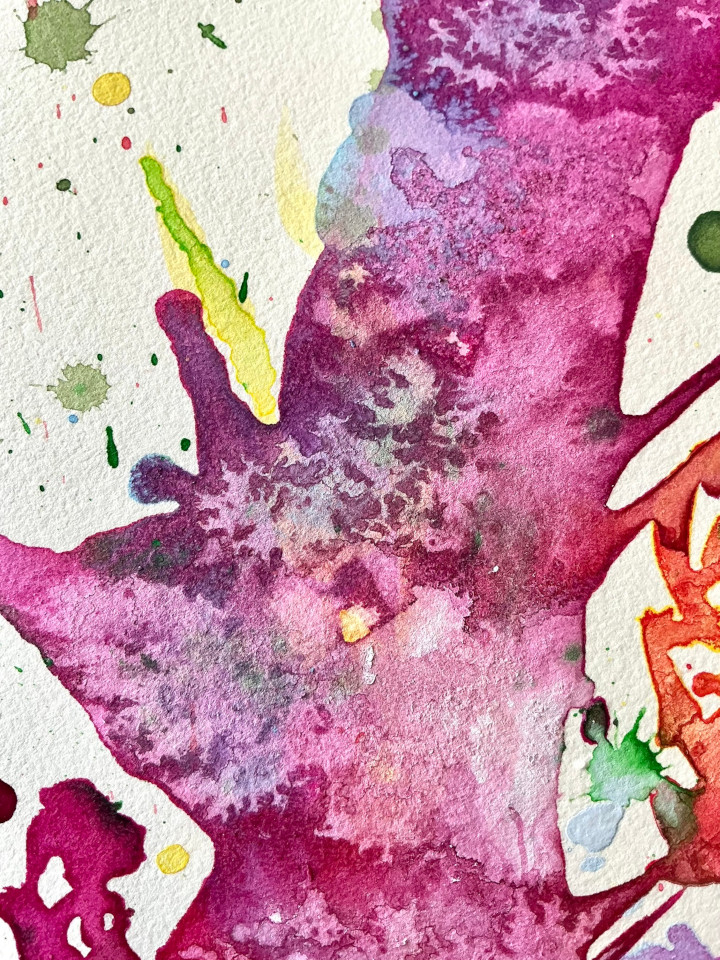
I am a Hungarian contemporary visual artist living and working in Finland, working primarily with mixed media. Creating art became a defining and survival-supporting part of my life relatively early on. Over several decades, my thinking has been shaped by personal trauma, as well as by my experiences relating to social justice, women’s and animal rights, and human dignity. I am convinced that traumas are worth transforming into steps for community building, shared development, and connection.
I was born in a post-communist country, which for a long time had been increasingly evolving into a hybrid regime. Self-expression and existential safety of artists were restricted in many ways. As a result, I lost my connection to art for almost a decade and a half, although writing poetry has been an important part of my life since 2010. For a long time, I worked with the rehabilitation of traumatized dogs. In January 2024, my husband and I emigrated to Finland.
The change opened up a new possibility for me to begin exploring the questions above through the language of visual art. Since 2024, I have been studying drawing and painting independently, developing my visual language through continuous practice and experimentation. The endless pine forests, exploring the Finnish archipelago, and the atmosphere of the harbors fill me with joy and constantly inspire me.


My vision
I want there to be more creativity, color and free self-expression in the world than oppression.
I believe that art has the power to make visible the connections that we often fail to notice in everyday life. My own experiences have taught me that empathy, human dignity, and freedom are unfortunately not inherent building blocks of our lives, but foundations that we must reinforce again and again.
As an artist, I therefore support the creation and preservation of a world in which every decision concerning our own bodies, our reproductive rights, our education and career choices, our economic security, and our life journeys as a whole is understood in terms of individual autonomy, empathy, human dignity and equality, animal welfare, and a responsible relationship with nature. A world in which these are not separate values, but integral parts of the same shared system.
Through my work, I do not seek to provide answers, but to create visual experiences that invite the viewer to pause, to feel the tension and difference between chaos and order, and to question their own relationship with nature. And to question the "traditional" social arrangements and mechanisms that humanity has constructed in the past, which are not necessarily viable in the present.
I believe that the more space we give to creation and the thinking that goes with it, the more people will find words and ways to express their emotions and experiences. They will be able to broaden their horizons and show their values.
Artist statement
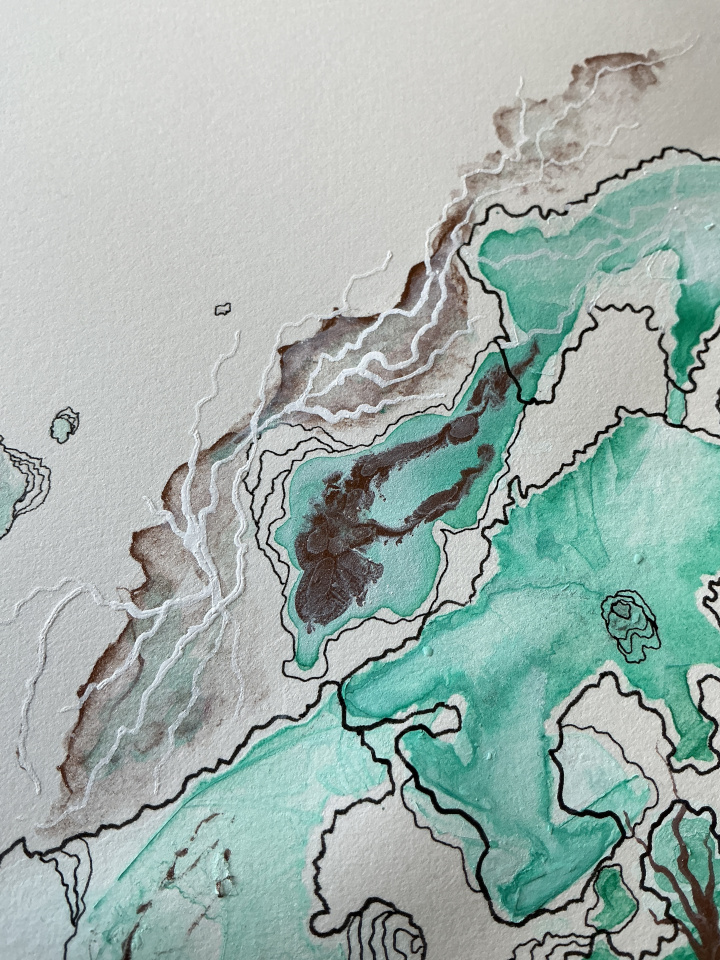
My work begins with the observation of nature and with personal experience. Through organic forms, abstraction, recognisable motifs from nature, and the layering of different materials, I explore the forms and structures emerging from living systems.
For me, nature is not merely a subject, but a way of thinking. Its recurring patterns, structures, adaptivity, and continuous transformation inspire my visual thinking. In my work, the coexistence of the organic and the geometric, the realistic and the abstract, the detailed and the loosely painted, the subtle and the intense creates tension. Vivid, high-energy colours, graphic marks, and layered surfaces draw attention not to an exact reproduction of nature, but to its transforming, interwoven structures and the sensations they evoke.
I work with watercolour, gouache, water-soluble wax pastel, and oil pastel, as well as other water-based and graphic media. Consciously utilising the different behaviours of the materials and their effects on one another. Oil pastel is particularly important to me because of its depth and tactile surface presence: it gives my work textural characteristics that I cannot create in the same way with other media. I particularly enjoy working on 640 gsm, 100% cotton, acid-free paper, which is not merely a support for the work but an integral part of the artwork itself. I consciously seek materials and processes that allow me to pursue an artistic and archival practice with the smallest possible ecological footprint. This includes the use of solvent-free, water-soluble materials, as well as having moved away from using varnishes and fixatives, choosing non-toxic materials, colors, and pigments, and using appropriate framing and UV-protective, anti-reflective glass to provide long-term protection for the works.
My works create visual spaces that simultaneously carry the traces of intuition and conscious decisions, while leaving room for the viewer’s own interpretation and possibility of connection.
Education
- Rehabilitation Dog Trainer - Hungarian OKJ qualification
- Dog Trainer - Hungarian OKJ qualification
- Veterinary Assistant - Hungarian OKJ qualification
- Dog Massage Therapist - Hungarian programme-accredited professional training
- 2008 - MA in pedagogy and Hungarian literature, University of Pécs
- 2003 - BA in Teacher Education, with a minor in Music, The Successor Institution of the Illyés Gyula Faculty of Education, University of Pécs
Grants & Awards
- Summer 2025 — Startup Grant, City of Espoo
- Winter 2025 — Startup Grant, City of Espoo
