
Living Structures
The Living Structures series explores the invisible structures that occasionally reveal themselves and enable connections between living beings, memories, environments, and communities.
Each work in the series approaches this question from a different perspective: through biological, ecological, cartographic, emotional, or symbolic connections. The paintings do not seek to depict nature literally, but rather draw attention to the recurring patterns and organising principles that appear across different forms of life and systems alike.
I believe that empathy begins when we recognise these connections.
Tap to enlarge the picture and read its story or long-tap to see its technical details.

Technical details
Green Oxygen

Technical details
For Ages

Technical details
Emergence

Technical details
What Lies Beneath

Technical details
Interwoven Structures

Technical details
The Minimalism of Mint

Technical details
Smile of a Blackberry

Technical details
Unity

Technical details
Next time it happens...

Technical details
Out of the Cell

Technical details
Revival
Animal Presence
In this series, I reinterpret the traditional animal portrait through contemporary visual means. I approach animals not merely as portrait subjects, but as living entities with their own presence and individuality.
Recognisable animal forms encounter organic and abstract elements, intense colours, graphic marks, and layered surfaces. The tension between realistic details and more freely treated visual elements allows me to preserve the individual character of the animal while moving beyond mere resemblance. The series explores how the animal portrait can express an animal's individuality, its unique relationship with a human, their shared memories, and what animal presence means in a person's life.
I understand the relationship between animals and humans as one of equals, in which the animal is neither a decorative motif nor a substitute for a human story, but an independent living being whose presence becomes the centre of the image in its own right.

Technical details
Willpower - Elixír

Technical details
Mischief - Szaladin

Technical details
Devotion - Álmos
Selected Works

Technical details
Felhő

Technical details
Rex

Technical details
Self-portrait

Technical details
Mansplaining - just the first step

Technical details
A Bouquet of Patriarchal Charm

Technical details
Date

Technical details
Blue Mood

Technical details
Summer Explodes with Green

Technical details
Flames of Summer

Technical details
Viktor, the Hungry Bird

Technical details
Where the Desert Ends

Technical details
Lack of Purple

Technical details
Growth

Technical details
Winter Field

Technical details
Shiba Inu

Technical details
Willow

Technical details
Álmos

Mansplaining – just the first step
⚠️ Content Warning: The following text contains distressing themes and is not suitable for children. Please consider your emotional well-being before reading.
Misogyny. A phenomenon deeply rooted in patriarchal societies, which can take the form of discrediting women, infantilizing them, ridiculing them, invalidating their expertise, insights, and emotions, and treating them as if they were invisible. In the long term, its goal is to restrict women, prevent them from developing their talents, and undermine their independence and self-confidence. In extreme cases, it deprives women of the opportunity to acquire knowledge that correlates with market demands, the opportunity to earn their own money, and thus the opportunity to support themselves. So that she wants nothing more than to serve the man, while depending on him emotionally, financially, and in every way. This is often achieved through legal commitments and irresponsible pressure to have children. The more women are tied down by children, the less time, energy, and opportunity they have to exist as independent individuals. She is more likely to drop out of the workforce, her social relationships fade, and she has no savings, which virtually guarantees her long-term, even decades-long financial dependence on the man. What is behind this? In fact, it is the minority complexes of the men involved. Having grown up in an unhealthy environment, they have not learned to take responsibility for the consequences of their actions, for themselves and for others, even as adults. And they have no intention of changing this, because it suits them. They only feel competent and confident by oppressing others and dominating them. This feeds their unfounded sense of entitlement. They typically avoid women who have a healthy personality, are confident, educated, and thrive independently. They often choose partners who are decades younger, whom they believe to be easily influenced and easily persuaded into an unequal relationship.
These men are typically characterized by verbal sexism and mansplaining. The latter refers to when a woman's competence is ignored and she is condescendingly explained the obvious. Unasked for. Often in situations where the woman knows more about a given topic and is an expert on it. Mansplaining can be disguised as excessive concern or unsolicited paternalism towards an adult, in other words someone who is socially, professionally, and personally equal. Or it can be disguised as "joking," which is actually a humorless, usually racist, sexist cliché repeated without thinking.
My oil pastel painting is a stand with the victims and survivors of misogyny. It calls for us to talk about the harmful nature of this phenomenon, to educate and learn. Let us do everything we can to ensure that the human rights of the younger generations are no longer trampled upon.
The colors and wavy shapes of the painting are vivid, seemingly cheerful, and catch the eye. It is as if a dreamlike fantasy image is projected before us. Seemingly. Unfortunately, in many societies, girls are prepared for a subordinate role from an early age with poorly chosen beliefs, outdated fairy tales, and an immature parental personality structure that develops in the absence of healthy role models. Neither their teenage years nor their young adulthood will be as colorful as this painting.
The male entities from the lower regions of the painting engage in loud, angry communication. Their huge mouths spew as they speak. Their drool mixes with their sweat on the ground, forming a puddle in which they stand. One of them is aggressive, while the other explains something important for him in a "joking" manner. It is not even certain that they are discussing the same topic. What they have in common is that they are both towering over a female figure, shouting over her head. Almost as if the sinking, broken-antlered creature in need of help were not even there. As if she were invisible. This kind of (verbal) presentation of oppression, although it causes harm to the victim, is also meant for other oppressors. No one else considers it honorable to use violence.
The pink, orange, and pale blue female figures have no mouths. Therefore, they cannot speak; they are mute. They symbolize all those who cannot speak because they would "pay" for getting help with their own physical integrity or that of their loved ones. Their powerful presence holds up a mirror to the indifferent systems that nurture monsters and cover up their deeds. All three female entities are objectified and dehumanized, reinforcing the grotesque quality of the painting. Their vibrant colors and balloon-like shapes playfully evoke the adjective "lighthearted." At the same time, it is clear that the thick, unbreakable leash and collar are their necklaces. Those at the other end of the leash, of course, do not realize that they too have become bound. By themselves. As caricatures of their own intentions and themselves. The point is that they believe they have gained something. Someone. But the airy creatures float away from them. Except the one who is paralyzed by the circumstances. She cannot escape. She sinks. Or does she? Could it be that she is not a deer with broken antlers after all? Could it be a phoenix with outstretched wings, destined to fly high? By the time the truth is revealed, perhaps even the figure waving the conductor's baton will realize that he was not actually conducting anything, but only had a cactus thorn stuck in his hand, and he was shaking it furiously in pain. If we join forces to support those in need and those already on their path to healing, if we do not look away when we see a call for help, we can create a norm that condemns violence. If we eliminate indifference, there will be no place left for perpetrators to hide. Every amplified voice weakens them. And every single word brings the moment of accountability closer. This is what the pile of rubbish made from the rotting grapevines represents in the painting: a collection of evil deeds that ultimately pours down on the head of the perpetrator.
The cluster of grapes mockingly points to the guy who thinks he's a big shot with his hat. Who is convinced that even the god who sits above the clouds bears his image. With his ridiculously long mustache, he imagines a cottage as his kingdom, where everything is permitted to him. Where he can break the rules, where there are no prohibitions that could stop him.
Mansplaining is not a harmless act, nor is it well-intentioned. It is usually just the tip of the iceberg. Behind it lies an entire worldview based on false beliefs and infused with violence, aimed at abusing other people. It is a gesture towards girls and women that some men believe they can make without facing any consequences.
I was 20 years old. For more than six years, I became a victim of my former college professor, who was 27 years older than me. He abused his position of power. He raped me multiple times and also abused me psychologically. Like my mother, he isolated me from my peers. He prevented me from escaping the corrupt hopelessness and deep poverty of a declining small town for years. He had a cottage. During an argument, he slammed my head against its concrete wall. But before that, he poured a bottle of mineral water over me so that I couldn't leave on my bike in the autumn cold, soaked to the skin. I froze. I couldn't escape. When I got home, I told my mother what had happened. She kindly invited the rapist to our apartment for coffee. To the place where I lived. Because, according to my mother, I deserved the beating. During those years, I also survived endocrine cancer. At the age of 23. It developed as a result of continuous trauma and hopelessness. My body was exhausted, unable to process any more of the horror that surrounded me. No one helped me. To the outside world, this abuser presented himself as a wonderful, cheerful, modest, and educated person. Today, I know that I was not his only victim. Sick people like him have a keen instinct for hunting down young girls and women who live in poor conditions or come from broken families. They know exactly who has no relatives, or who can’t count on their family if something happens. They see them as “easy prey” — girls no one will protect or help, and with whom they can do whatever they want.
In 2024, I broke off contact with my mother. My decision was influenced by the fact that she is still in contact with this rapist to this day.

About me
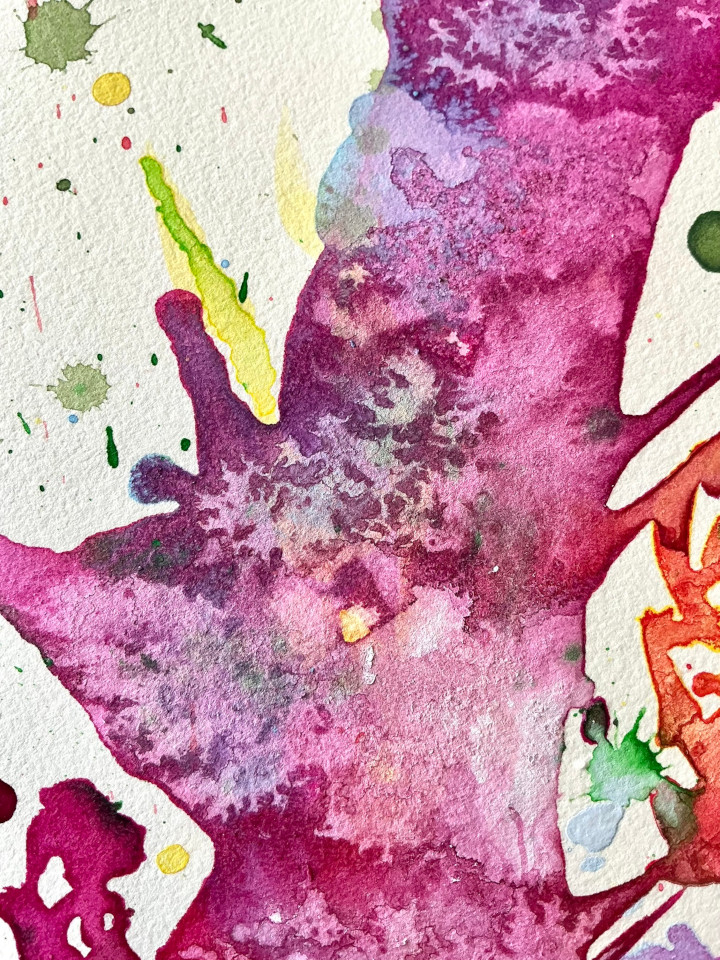
I am a Hungarian contemporary visual artist living and working in Finland, working primarily with mixed media. Creating art became a defining and survival-supporting part of my life relatively early on. Over several decades, my thinking has been shaped by personal trauma, as well as by my experiences relating to social justice, women’s and animal rights, and human dignity. I am convinced that traumas are worth transforming into steps for community building, shared development, and connection.
I was born in a post-communist country, which for a long time had been increasingly evolving into a hybrid regime. Self-expression and existential safety of artists were restricted in many ways. As a result, I lost my connection to art for almost a decade and a half, although writing poetry has been an important part of my life since 2010. For a long time, I worked with the rehabilitation of traumatized dogs. In January 2024, my husband and I emigrated to Finland.
The change opened up a new possibility for me to begin exploring the questions above through the language of visual art. Since 2024, I have been studying drawing and painting independently, developing my visual language through continuous practice and experimentation. The endless pine forests, exploring the Finnish archipelago, and the atmosphere of the harbors fill me with joy and constantly inspire me.


My vision
I want there to be more creativity, color and free self-expression in the world than oppression.
I believe that art has the power to make visible the connections that we often fail to notice in everyday life. My own experiences have taught me that empathy, human dignity, and freedom are unfortunately not inherent building blocks of our lives, but foundations that we must reinforce again and again.
As an artist, I therefore support the creation and preservation of a world in which every decision concerning our own bodies, our reproductive rights, our education and career choices, our economic security, and our life journeys as a whole is understood in terms of individual autonomy, empathy, human dignity and equality, animal welfare, and a responsible relationship with nature. A world in which these are not separate values, but integral parts of the same shared system.
Through my work, I do not seek to provide answers, but to create visual experiences that invite the viewer to pause, to feel the tension and difference between chaos and order, and to question their own relationship with nature. And to question the "traditional" social arrangements and mechanisms that humanity has constructed in the past, which are not necessarily viable in the present.
I believe that the more space we give to creation and the thinking that goes with it, the more people will find words and ways to express their emotions and experiences. They will be able to broaden their horizons and show their values.
Artist statement
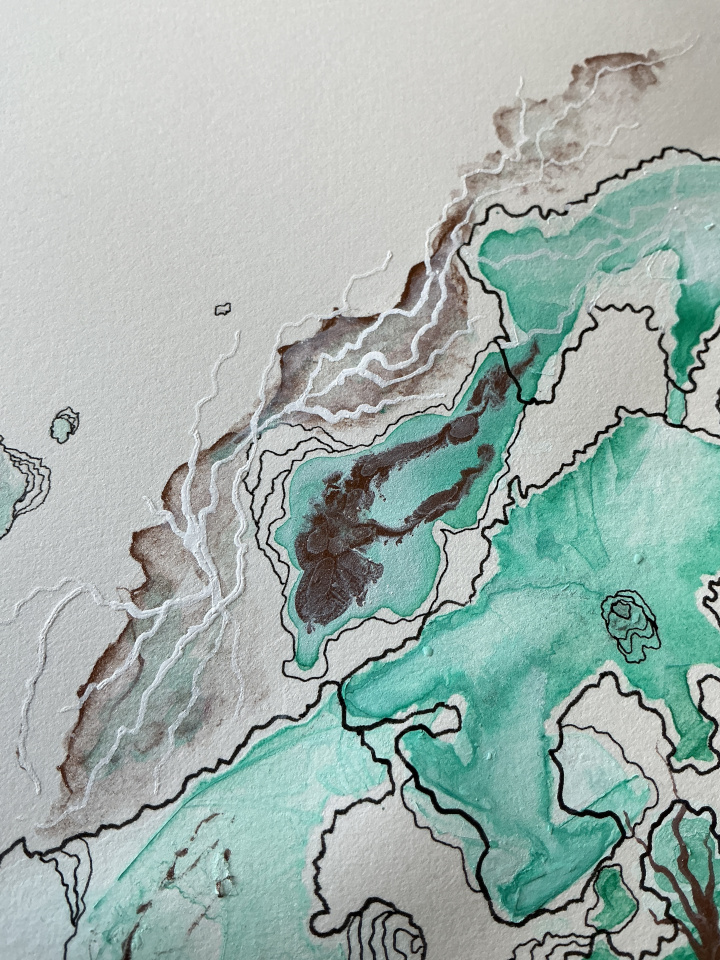
My work begins with the observation of nature and with personal experience. Through organic forms, abstraction, recognisable motifs from nature, and the layering of different materials, I explore the forms and structures emerging from living systems.
For me, nature is not merely a subject, but a way of thinking. Its recurring patterns, structures, adaptivity, and continuous transformation inspire my visual thinking. In my work, the coexistence of the organic and the geometric, the realistic and the abstract, the detailed and the loosely painted, the subtle and the intense creates tension. Vivid, high-energy colours, graphic marks, and layered surfaces draw attention not to an exact reproduction of nature, but to its transforming, interwoven structures and the sensations they evoke.
I work with watercolour, gouache, water-soluble wax pastel, and oil pastel, as well as other water-based and graphic media. Consciously utilising the different behaviours of the materials and their effects on one another. Oil pastel is particularly important to me because of its depth and tactile surface presence: it gives my work textural characteristics that I cannot create in the same way with other media. I particularly enjoy working on 640 gsm, 100% cotton, acid-free paper, which is not merely a support for the work but an integral part of the artwork itself. I consciously seek materials and processes that allow me to pursue an artistic and archival practice with the smallest possible ecological footprint. This includes the use of solvent-free, water-soluble materials, as well as having moved away from using varnishes and fixatives, choosing non-toxic materials, colors, and pigments, and using appropriate framing and UV-protective, anti-reflective glass to provide long-term protection for the works.
My works create visual spaces that simultaneously carry the traces of intuition and conscious decisions, while leaving room for the viewer’s own interpretation and possibility of connection.
Education
- Rehabilitation Dog Trainer - Hungarian OKJ qualification
- Dog Trainer - Hungarian OKJ qualification
- Veterinary Assistant - Hungarian OKJ qualification
- Dog Massage Therapist - Hungarian programme-accredited professional training
- 2008 - MA in pedagogy and Hungarian literature, University of Pécs
- 2003 - BA in Teacher Education, with a minor in Music, The Successor Institution of the Illyés Gyula Faculty of Education, University of Pécs
Grants & Awards
- Summer 2025 — Startup Grant, City of Espoo
- Winter 2025 — Startup Grant, City of Espoo
