
Living Structures
The Living Structures series explores the invisible structures that occasionally reveal themselves and enable connections between living beings, memories, environments, and communities.
Each work in the series approaches this question from a different perspective: through biological, ecological, cartographic, emotional, or symbolic connections. The paintings do not seek to depict nature literally, but rather draw attention to the recurring patterns and organising principles that appear across different forms of life and systems alike.
I believe that empathy begins when we recognise these connections.
Tap to enlarge the picture and read its story or long-tap to see its technical details.

Technical details
Green Oxygen

Technical details
For Ages

Technical details
Emergence

Technical details
What Lies Beneath

Technical details
Interwoven Structures

Technical details
The Minimalism of Mint

Technical details
Smile of a Blackberry

Technical details
Unity

Technical details
Next time it happens...

Technical details
Out of the Cell

Technical details
Revival
Animal Presence
In this series, I reinterpret the traditional animal portrait through contemporary visual means. I approach animals not merely as portrait subjects, but as living entities with their own presence and individuality.
Recognisable animal forms encounter organic and abstract elements, intense colours, graphic marks, and layered surfaces. The tension between realistic details and more freely treated visual elements allows me to preserve the individual character of the animal while moving beyond mere resemblance. The series explores how the animal portrait can express an animal's individuality, its unique relationship with a human, their shared memories, and what animal presence means in a person's life.
I understand the relationship between animals and humans as one of equals, in which the animal is neither a decorative motif nor a substitute for a human story, but an independent living being whose presence becomes the centre of the image in its own right.

Technical details
Willpower - Elixír

Technical details
Mischief - Szaladin

Technical details
Devotion - Álmos
Selected Works

Technical details
Felhő

Technical details
Rex

Technical details
Self-portrait

Technical details
Mansplaining - just the first step

Technical details
A Bouquet of Patriarchal Charm

Technical details
Date

Technical details
Blue Mood

Technical details
Summer Explodes with Green

Technical details
Flames of Summer

Technical details
Viktor, the Hungry Bird

Technical details
Where the Desert Ends

Technical details
Lack of Purple

Technical details
Growth

Technical details
Winter Field

Technical details
Shiba Inu

Technical details
Willow

Technical details
Álmos

Date
⚠️ Content Warning: The following text contains distressing themes and is not suitable for children. Please consider your emotional well-being before reading.
I am reading news from Hungary. A few years ago, a female university student was raped in her own dorm room. Every Hungarian authority abandoned her, retraumatizing her in the process. Until she turned to a human rights advocate, the hospital refused to take a medical report, and the police refused to file her complaint, mocking her instead: “Off you go to the afterparty!” Yet the perpetrator admitted his act in writing, and there was other clear physical evidence as well. The leadership of the University of Fine Arts allowed the perpetrator to stay in the dormitory until he graduated. It was the victim who had to leave. The perpetrator even took part in an Erasmus Programme, while the Hungarian university failed to inform the foreign partner institution that there was an ongoing procedure against the male student. The university’s chancellor called the case a “conflict.” According to him, “if students quarrel, that’s their business.” In recent days, the Hungarian justice system acquitted the rapist. The court justified its decision by stating that “lack of consent is not yet violence.” And the university believes that “it would have been a shame to ruin a talented young man’s future over one misstep.” Why isn’t the conversation about the victim’s future and her need for support?! There is currently a petition being circulated with the aim of introducing the concept of consent into Hungarian law. I signed the petition. Hundreds of former and current students of the University of Fine Arts are protesting in outrage. In front of the building, the following message was displayed: “Silence is not consent. Stillness is not consent. Refusing to use a condom is also rape!”
The coincidence is astonishing. I had started the sketches for my painting days before social media, and later the press, reported on yet another shocking case of misogyny, one fueled also by the Hungarian government. What motivated me? The fact that Instagram blocked the promotion of my previous painting (Mansplaining – just the first step), which I created precisely for the International Day for the Elimination of Violence Against Women (25 November), as a gesture of solidarity with victims and survivors. And of course, I was also motivated by my own story and my healing.
My painting depicts an enclosed space. Inside it, pressure, coldness, mechanical monotony, and a sharp sense of the unspoken all strengthen the feeling of hopelessness and irreversibility. Are there truly no windows and no door, or are they simply unreachable, invisible? Either way, they cannot fulfill their function if one’s intention is free action and deciding whether to leave a place or not. From where is it easier to leave? A box or an apartment? In this space, there are no objects. Nothing to rearrange or to refer to by another name. It is not clear whether the side walls are made of transparent glass or wooden planks. Whoever ends up in this space cannot see out, and cannot see any way out. Nor do they see other people around them with whom they might find the exit together. What is more, the individual who enters the space is not visible. It is not visible what stands behind them. The only possible action is to look at the bright wall opposite, covered with countless red signs. As if a story were painted and written on the wall at the same time. And yet the letters are unreadable. What is their meaning? What do they say? For the one who looks from the inside, perhaps the marks give some comfort and the sense that they are not entirely alone. For the one who looks from the outside, having pushed someone into this space, they should represent a confrontation with their own actions!
I was 17 years old, practicing a piece one afternoon in one of the piano rooms. I loved playing the piano. Suddenly the door opened and one of my music teachers walked in. He started talking about how I was playing the triplet rhythm incorrectly in one of the voice parts. I didn’t understand what he meant. My piano teacher said my rhythms were flawless. He showed me. Meanwhile, he suddenly kissed me, and I froze on the piano stool. He reached under my long, oversized brown turtleneck sweater and started groping my breasts. This was the first sexual abuse committed by one of my teachers in my life. And it was also the first kiss of my life. It wasn’t how I imagined it. He sighed contentedly and said it felt good to him. By the time I came to my senses, he was already outside the room. I felt voiceless, dirty, and lost. I was broken. When I told my mother, she just shrugged and responded by asking why I went there and why I let it happen. She slut-shamed me. She had no intention of helping or standing up for me. She didn’t care what happened to me. Classic victim-blaming behavior. The next day she advised me to shut my mouth if I really wanted to go to the music academy. She told me that I didn’t need to study music, because it was an expensive thing. If back then I had been stubborn, then now I should bear the consequences of it and attend the free lessons the teacher had previously offered. (We had no money for a private teacher, nor for a piano at home. Interestingly, my mother somehow always had enough for a few packs of cigarettes a day.)
Another memory I have of the same teacher is that he stopped his car, and I heard the car door lock click. Even though I asked him, he didn’t unlock it. I couldn’t escape from the car, and from the shock I didn’t even know where we were. It was winter and dark. He drove to the edge of the city. He didn’t want anyone to see him molesting his 17-year-old student. He started groping me and undressing me. No matter how much I begged him to stop, that I didn’t want it, he kept repeating that he knew I wanted it too. “Just a little.” I couldn’t push his hand away, it was everywhere. After a while I gave up, I let it happen, just waited for him to finish. I dissociated from my body. To this day I remember the brand of his car and its license plate.
After all this my mother prevented me from going to the music academy in another city (if I dared to submit the application, I could go live on the street), I ended up studying pedagogy, which didn’t interest me at all. One summer evening I had a crying fit from my mother’s and grandmother’s abusive insults. I ran out of the house crying; I had nowhere to go and didn’t know where I would sleep. I literally ran into one of my college teachers. Through sobs I asked him if he or someone he knew had a free apartment or even a half-room for that night where I could be safe and sleep. I told him what was happening at home and that I had no one to turn to for help. I was naïve and traumatized in every area of my life. He said he was currently a “temporarily single,” and that he would sleep in his wife’s room, so I could be in the living room. I believed him. I trusted him, as he was a well-known figure in the small town. He pinned me down. I couldn’t move under him. No matter how I struggled, both verbally and physically. He restrained me and pressed his hundred kilos onto me. He was 27 years older than me. After a while, he noticed I had gone silent and stopped moving. He didn’t care. He didn’t stop. He raped me. Sometimes I caught sight of his disgusting, pleasure-drunk face, and I knew I had to survive. There was no one who could help me back then, but one day I would leave the town behind, all of Hungary behind. I just had to survive. One day at a time. I felt as if I were not only dissociating from my body, but as if I were also separated from that pure and hopeful person I had once been. That night it went on for hours. All the while one of his favorite pieces was playing on loop. Turned up loud. Ravel’s Bolero.

About me
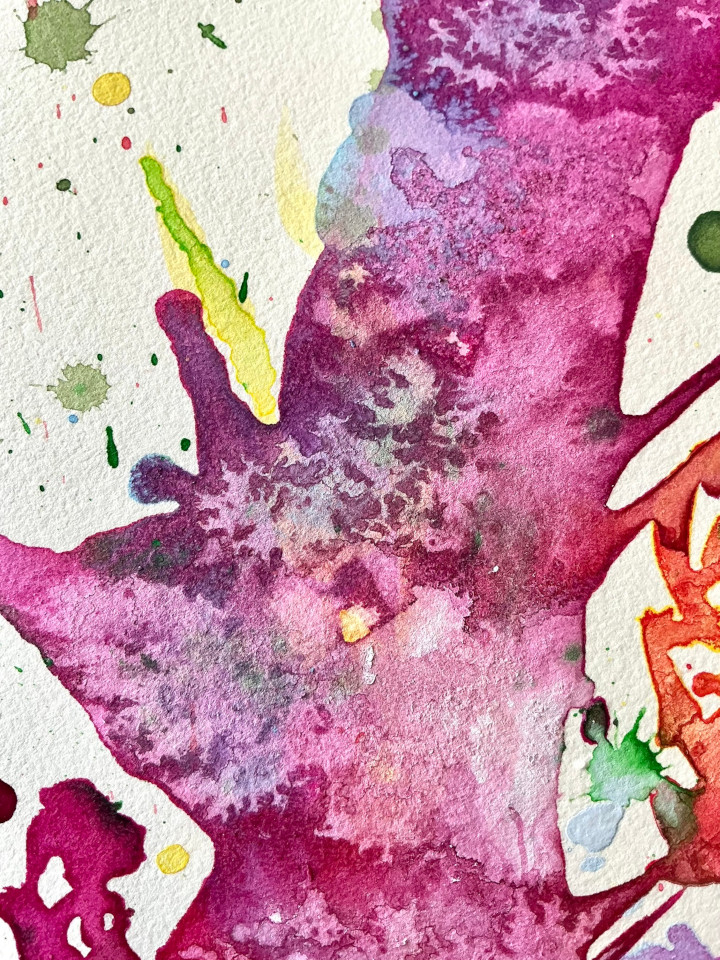
I am a Hungarian contemporary visual artist living and working in Finland, working primarily with mixed media. Creating art became a defining and survival-supporting part of my life relatively early on. Over several decades, my thinking has been shaped by personal trauma, as well as by my experiences relating to social justice, women’s and animal rights, and human dignity. I am convinced that traumas are worth transforming into steps for community building, shared development, and connection.
I was born in a post-communist country, which for a long time had been increasingly evolving into a hybrid regime. Self-expression and existential safety of artists were restricted in many ways. As a result, I lost my connection to art for almost a decade and a half, although writing poetry has been an important part of my life since 2010. For a long time, I worked with the rehabilitation of traumatized dogs. In January 2024, my husband and I emigrated to Finland.
The change opened up a new possibility for me to begin exploring the questions above through the language of visual art. Since 2024, I have been studying drawing and painting independently, developing my visual language through continuous practice and experimentation. The endless pine forests, exploring the Finnish archipelago, and the atmosphere of the harbors fill me with joy and constantly inspire me.


My vision
I want there to be more creativity, color and free self-expression in the world than oppression.
I believe that art has the power to make visible the connections that we often fail to notice in everyday life. My own experiences have taught me that empathy, human dignity, and freedom are unfortunately not inherent building blocks of our lives, but foundations that we must reinforce again and again.
As an artist, I therefore support the creation and preservation of a world in which every decision concerning our own bodies, our reproductive rights, our education and career choices, our economic security, and our life journeys as a whole is understood in terms of individual autonomy, empathy, human dignity and equality, animal welfare, and a responsible relationship with nature. A world in which these are not separate values, but integral parts of the same shared system.
Through my work, I do not seek to provide answers, but to create visual experiences that invite the viewer to pause, to feel the tension and difference between chaos and order, and to question their own relationship with nature. And to question the "traditional" social arrangements and mechanisms that humanity has constructed in the past, which are not necessarily viable in the present.
I believe that the more space we give to creation and the thinking that goes with it, the more people will find words and ways to express their emotions and experiences. They will be able to broaden their horizons and show their values.
Artist statement
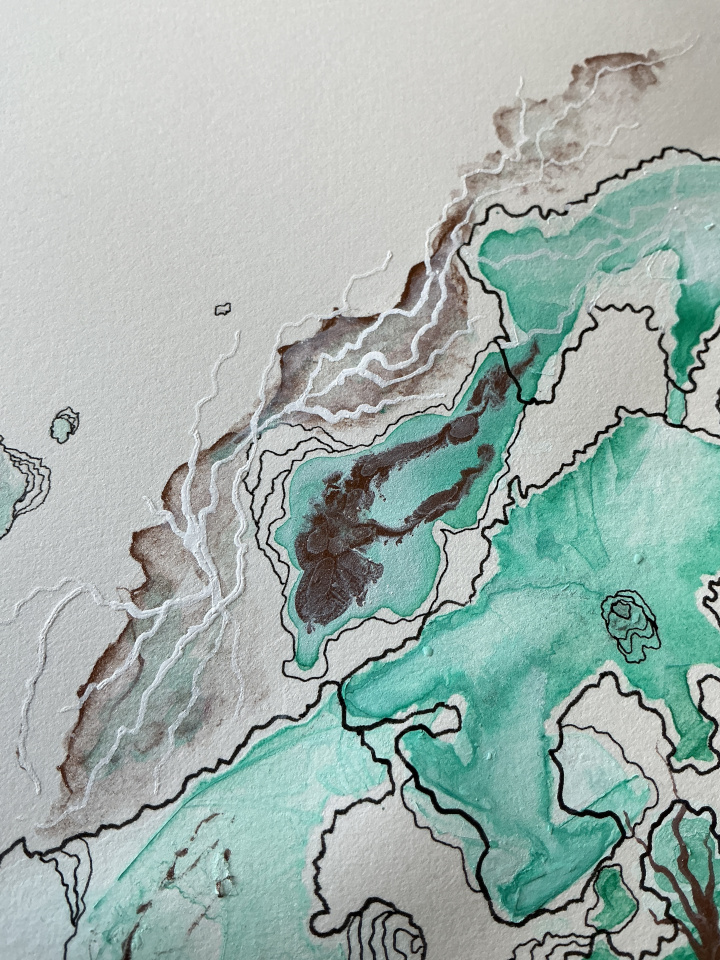
My work begins with the observation of nature and with personal experience. Through organic forms, abstraction, recognisable motifs from nature, and the layering of different materials, I explore the forms and structures emerging from living systems.
For me, nature is not merely a subject, but a way of thinking. Its recurring patterns, structures, adaptivity, and continuous transformation inspire my visual thinking. In my work, the coexistence of the organic and the geometric, the realistic and the abstract, the detailed and the loosely painted, the subtle and the intense creates tension. Vivid, high-energy colours, graphic marks, and layered surfaces draw attention not to an exact reproduction of nature, but to its transforming, interwoven structures and the sensations they evoke.
I work with watercolour, gouache, water-soluble wax pastel, and oil pastel, as well as other water-based and graphic media. Consciously utilising the different behaviours of the materials and their effects on one another. Oil pastel is particularly important to me because of its depth and tactile surface presence: it gives my work textural characteristics that I cannot create in the same way with other media. I particularly enjoy working on 640 gsm, 100% cotton, acid-free paper, which is not merely a support for the work but an integral part of the artwork itself. I consciously seek materials and processes that allow me to pursue an artistic and archival practice with the smallest possible ecological footprint. This includes the use of solvent-free, water-soluble materials, as well as having moved away from using varnishes and fixatives, choosing non-toxic materials, colors, and pigments, and using appropriate framing and UV-protective, anti-reflective glass to provide long-term protection for the works.
My works create visual spaces that simultaneously carry the traces of intuition and conscious decisions, while leaving room for the viewer’s own interpretation and possibility of connection.
Education
- Rehabilitation Dog Trainer - Hungarian OKJ qualification
- Dog Trainer - Hungarian OKJ qualification
- Veterinary Assistant - Hungarian OKJ qualification
- Dog Massage Therapist - Hungarian programme-accredited professional training
- 2008 - MA in pedagogy and Hungarian literature, University of Pécs
- 2003 - BA in Teacher Education, with a minor in Music, The Successor Institution of the Illyés Gyula Faculty of Education, University of Pécs
Grants & Awards
- Summer 2025 — Startup Grant, City of Espoo
- Winter 2025 — Startup Grant, City of Espoo
